In our workshops, we don’t do “copycat” art. Even when we start with a theme—like a hot air balloon drifting through the sky—the goal isn’t for every child to produce the same image. We want them to decide if that sky is a fiery sunset, a stormy midnight, or… something else entirely.
In a recent class, a few kids asked if they could change the scope completely. Instead of a balloon, they wanted to paint a rocket ship in deep space. Because our projects are built on concepts and techniques rather than strict blueprints, we leaned into it. The “sky” became “space,” but the learning stayed the same.
However, that level of freedom can be confronting. For kids used to being told exactly what to do, a blank canvas can feel like a mountain they aren’t ready to climb.
The “Starry Night” Struggle: A Case Study in Resilience
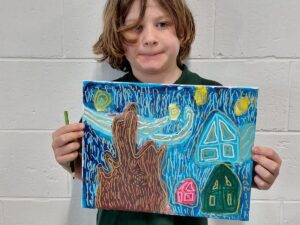
I want to tell you about a boy in our after-school class. He originally wanted to paint the Mona Lisa. As he sat with the idea, his vision shifted to The Starry Night.
This is the “scary” part of kid-led art. The ambition is high, but the path isn’t paved. When he—and several other kids—hit that wall of “I don’t know what to do,” we didn’t pick up the brush for them. Instead, we turned to a reference we love: The Dot by Peter H. Reynolds.
We talked about the character Vashti’s frustration and how “I don’t know” is often just a sign of feeling the pressure to come up with something “perfect.”
The “Sit on Your Hands” Method
As an educator, my instinct is to jump in. I have a vision of how the painting “should” look, and I’ll be honest: there’s an immature part of my ego that occasionally wants to be proved right. I find myself thinking, “If they do it that way, it won’t work,” just so I can say I told them so.
But being the adult in the room means role-modeling emotional regulation. When this student would say, “I want to change my design” or “I’m tired,” I knew he wasn’t actually bored. He was uncomfortable.
- We didn’t give him an easy out: We didn’t give him permission to start over or give up.
- We gave him space: We acknowledged the feeling. “It’s hard to come up with something, isn’t it?” or “It’s okay to feel sad or frustrated right now.”
By sitting on my hands and offering guidance instead of “fixing” the work, I allowed him to work through the struggle.
The Analog Process (aka canvas, paint and brush): Building Trust
To help him move through the frustration, we focused on a repeatable process that gives kids a sense of control:
- Practice: Drawing on paper first to “get the wiggles out” of the idea.
- Layering: Starting with the background, then the second layer, then infilling.
- The Details: Finishing with Posca pens to make the vision “pop.”
The Result: Better Than Expected
Throughout the project, he learned how to mix colors and manage design, but he also learned to trust his instinct. Every time I step back and let a child take the lead, their way turns out better, weirder, and more original than my “vision” ever was. When we let kids own the process—even the messy, frustrated parts—they don’t just leave with a painting. They leave with the knowledge that they can handle “the hard stuff.”
Common Questions About Our Student-Led Art Classes:
- Do you use step-by-step instructions? No, we provide themes and techniques (like layering and sketching) so kids can lead their own designs.
- What if my child gets frustrated? We view frustration as a learning tool. We help kids sit with “uncomfortable” emotions rather than taking over the project for them.
- Is this better than digital art? We focus on “analog” art because it requires patience, physical colour mixing, and problem-solving that screens can’t replicate.
Click here for our Upcoming Workshops
