It’s so easy to forget to breathe sometimes – to pause and use this technique, as simple and effective as it may be, as our first response when our brain and body go into freak-out mode. So often, we become so overwhelmed in the moment that any rational part of our brain clouds over, ensuring the ability to think of a “proper” breathing technique feels nearly impossible. And honestly, you’re not alone, that’s okay.
Throughout this blog, we’re going to break down the effect that deep, controlled breathing has on our nervous system and overall health – for both you and your child. The idea is to understand how we can practise mindfulness in real, everyday moments. Learning how to stay in control of our breathing, especially when life starts feeling clouded and overwhelming.
Breathing at its most basic
Breathing is the most basic function of being human – it literally keeps us alive. We do it all day, every day, without so much as a second of thinking, allowing our brain and body to function, as we move through our busy routines – work, school, pick-ups, and everything that comes between. So why is it that during those emotional moments, our bodies don’t naturally engage controlled breathing as a coping mechanism? Why is it that when our thoughts become foggy and our emotions feel difficult to manage, we don’t instinctively pause and regulate?
Well, that’s where our caveman or fight or flight response systems kick in.
What is the caveman response?
Well, think of it this way – imagine you wake up in the morning. As you open your eyes and become aware of your surroundings, you notice a tiger sitting nearby, waiting for you to step out of bed. Instantly, your body reacts. Your heartbeat speeds up, your breathing becomes laboured and shallow, your palms begin to sweat, and you feel a rush of adrenaline move through your body.
Your brain switches almost instantaneously into survival mode – instinctively sending a signal to your heart to pump blood to enable you to run away (flight), fight or freeze. This is to do everything it can to protect and keep you safe, a very useful feature of your brain.
The reality is – whilst most of us aren’t waking up next to tigers, our bodies tend to react in very similar ways during everyday stressful moments. While being late to a meeting is not as dangerous as waking up next to a tiger, it can feel like an extremely dangerous problem. The feelings you feel in the moment is the brain telling you to run away, fight or freeze. This is not always helpful or useful because its when we tend to catastrophise or overreact. Our feelings drive our behaviour.
Let’s think of our children. Regulating emotions can be complicated at any stage of our life, especially when we are still learning to understand how we are feeling and when. For kids, especially situations like a disagreement with a friend, feeling overwhelmed in the classroom setting or even just the simple practise of being told “no” can trigger a similar caveman response. Their brain interprets the situation as a danger or threat, and instead of stepping back and pausing for a moment, their bodies will go into overdrive as a form of instinctive protection – fast breathing, racing thoughts, challenging & big emotions in a short period of time. It is important to recognise, at whatever stage of life we are in, this survival instinct is there to protect us. It helps us make quick, in-the-moment decisions when it truly matters. But the question remains – how do we regulate in those moments, before our body takes over
Well… how about we start with something as simple as breathing?
Let’s give breathing a chance.
When we slow down our breathing and give our body a chance to take a step back and assess the reality of a situation, we are essentially sending a message to our nervous system that “it’s okay, we are safe, we can stand down”.
The science bit (don’t worry, we will keep it simple)
When we breathe deeply and slowly, we activate something in our body called the parasympathetic nervous system – the part of our body responsible for our rest and recovery. This one counteracts the caveman response. Deep breathing stimulates the vagus nerve. A nerve running from your brain all the way through your body, signalling to your muscles, heart rate, and mind that the threat has passed. What is the result of this? A clearer head, slower thoughts, a slower heartbeat and more relaxed muscles.
For everyone, this is important. But for our children, this is a particularly powerful tool to engage and develop. As our nervous system develops during childhood, swinging between calm and overwhelmed can be even more heightened and dramatic for children. However, the good news with this is that children typically respond incredibly well to simple and guided breathing, especially when a trusted adult is with them. So, in those big moments – throughout the meltdowns, tears and the door slams before exchanging heated words, try stepping back and engaging in a single, slow and visible breath. You might be surprised how much it changes the room’s atmosphere.
Try these breathing techniques.
A simple, yet highly effective breathing technique for both adults and children is box breathing, this technique can be done efficiently taking up two minutes out of your day.
Box Breathing.
- Breathe in slowly through your nose for 4 counts.
- Hold your breath gently for 4 counts.
- Breathe out slowly through your mouth for 4 counts.
- Hold again for 4 counts.
Repeat this exercise 3-4 times and notice the shift in your body, and how it begins to settle.
4-7-8 Breathing.
- Breathe in quietly through your nose for 4 counts.
- Hold your breath for 7 counts.
- Breathe out fully through your mouth for 8 counts – let it be audible like a loud whoosh.
Bonus: this one can be as silly as possible, as sometimes engaging a sense of innocence and humour in our breathing can help our body relax even more – try throwing your hands above your head when you breathe in and as you exhale after 7 counts throw them down by your side, like you are throwing away your stress from your body.
Repeat this exercise 3-4 times and notice the shift in your body, and mind and how it responds.
Belly Breathing.
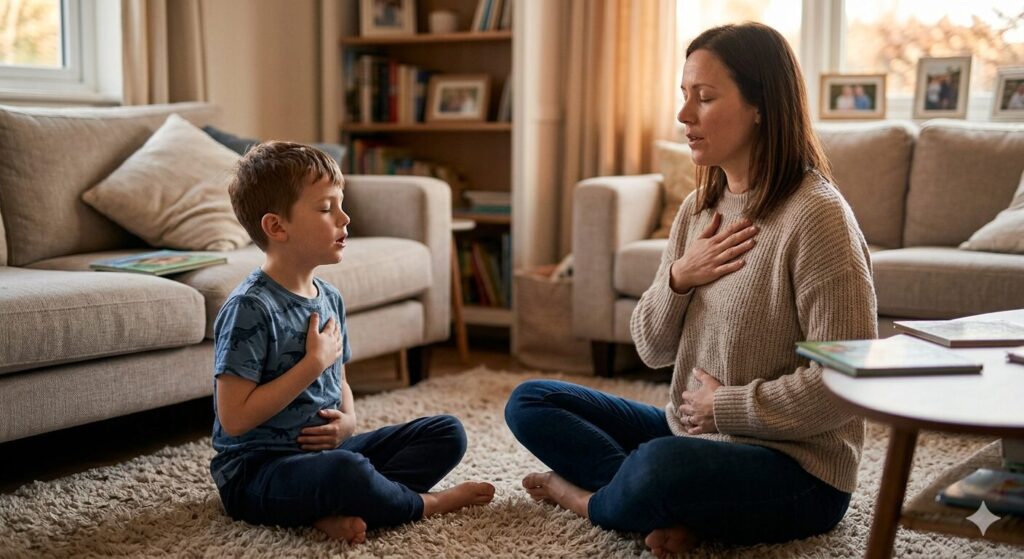
- Place one hand on your chest and one hand on your belly.
- Breathe in slowly through your nose – focus on letting your belly rise, not your chest.
- Breathe out slowly through your mouth – feel your belly gently fall.
Repeat this simple exercise, focusing on keeping the chest as still as possible.
And breathe.
So, there you have it – that doesn’t seem so tricky, does it? Three simple breathing techniques for you to put away in your back pocket for both you and your child whenever you need them. No equipment or expertise required, just you, your breath and a willingness to pause for a moment and to let your moment, no matter how big or small, pass.
The reality with breathing and finding your calm in the middle of a freakout is that it isn’t expected to be perfect. You don’t need to remember every single count and follow the specific rhythms in the middle of your moment, the importance is centred around connecting your brain, heart, muscles and your nervous system and finding a connection to understand you are safe and okay. Giving yourself the choice to slow down, even just marginally and come back to something your body already knows how to do.
On the days where it all goes out the window – where that tiger lying next to your bed takes over and your rational thinking goes offline, that’s okay too. That is called being human. Make sure you give yourself or your child some space to be human in that moment, take a breath when you are ready and try again. The wonderful part about breathing and being human is that we can always try again.
Breathing will always be there, even when your brain and body convince you it can’t possibly help you in the clouded moments. So go on, your breath is waiting.
Turn stressful meltdowns into moments of calm and connection. Our Calm Cards provide 30 practical, easy-to-use tools—including effective breathing techniques—designed to help your child navigate tricky situations with confidence. Start building your child’s emotional regulation skills today.
Set up a dedicated space in your home that helps your child settle and develop vital emotional regulation skills. Not sure what to include? Get 30 Expert Tips for Your Calm Corner
